The Ultimate Guide to Understanding Twin Screw Extruder Gearboxes:Welcome to the ultimate guide on twin screw extruder gearboxes! If you're in the manufacturing industry or have an interest in machinery, this comprehensive guide will provide you with everything you need to know about twin screw extruder gearboxes. From understanding the basics to exploring the different types and components, we'll delve into the inner workings of this crucial component. Whether you're a beginner looking to expand your knowledge or an experienced professional seeking to optimize your production processes, this guide has got you covered. We'll explore the advantages and applications of twin screw extruder gearboxes, as well as provide valuable insights into maintenance and troubleshooting. With our expertly crafted content, you can expect a seamless blend of technical information and practical advice.
In twin-screw extruder production, screw elements are core components, and their compatibility directly affects equipment performance and production efficiency. Whether you are using ZSK, Coperion, Leistritz, or other brands of twin-screw extruders, selecting the right screw elements is key to ensur
Twin Screw Elements Compatible with ZSK Extruders – High-Precision Replacement Parts for Polymer CompoundingIn the global compounding industry, maintaining stable output, consistent quality, and reliable machine performance heavily depends on the condition of the screw elements. For users operating
The K 2025 – International Trade Fair for Plastics and Rubber will take place from October 8–15, 2025, in Düsseldorf, Germany. As a trusted innovator in twin screw extruder spare parts manufacturing, Zhitian will present its latest technologies and material solutions at Booth 8B D11-15, highlighting
In manufacturing industries, efficiency is a critical factor that determines the success and profitability of operations.
When it comes to extrusion processes, a well-designed twin screw extruder is a critical piece of machinery for producing high-quality products in a variety of industries, including plastics, rubber, food, and pharmaceuticals.
Extruder gears play a pivotal role in various industrial applications, particularly in machinery like twin-screw extruders. These gears are the unsung heroes that ensure smooth material flow, precise operation, and high efficiency. However, one question that frequently arises is whether extruder gea
Reduction gearboxes are essential components in industrial machinery, including extruders. These mechanical systems are specifically designed to reduce the speed of a motor while increasing the torque output. In extruders, the reduction gearbox plays a vital role in optimizing performance, ensuring
Gearboxes are indispensable components in many mechanical systems, playing a crucial role in transmitting power and torque while regulating speed. Whether in automotive, industrial, or extrusion machinery, gearboxes ensure smooth and efficient operations. In extrusion systems, particularly, extruder
Extruders are vital components in various industrial applications, particularly in the manufacturing of plastics, food processing, and metalworking. Among the integral parts of an extruder is the extruder barrel, which, in conjunction with the screw, plays a pivotal role in material processing. This
| Availability: | |
|---|---|
| Quantity: | |
zhitian
![]()
- APV -KOBE -OMC
- Buhler -KraussMaffei -Theysohn
- Buss -Berstorff- -Toshiba
- Clextral -Labtech -USEON
- Coperon -Lantai - others
- JSW -Leistritz
- Keya -Maris
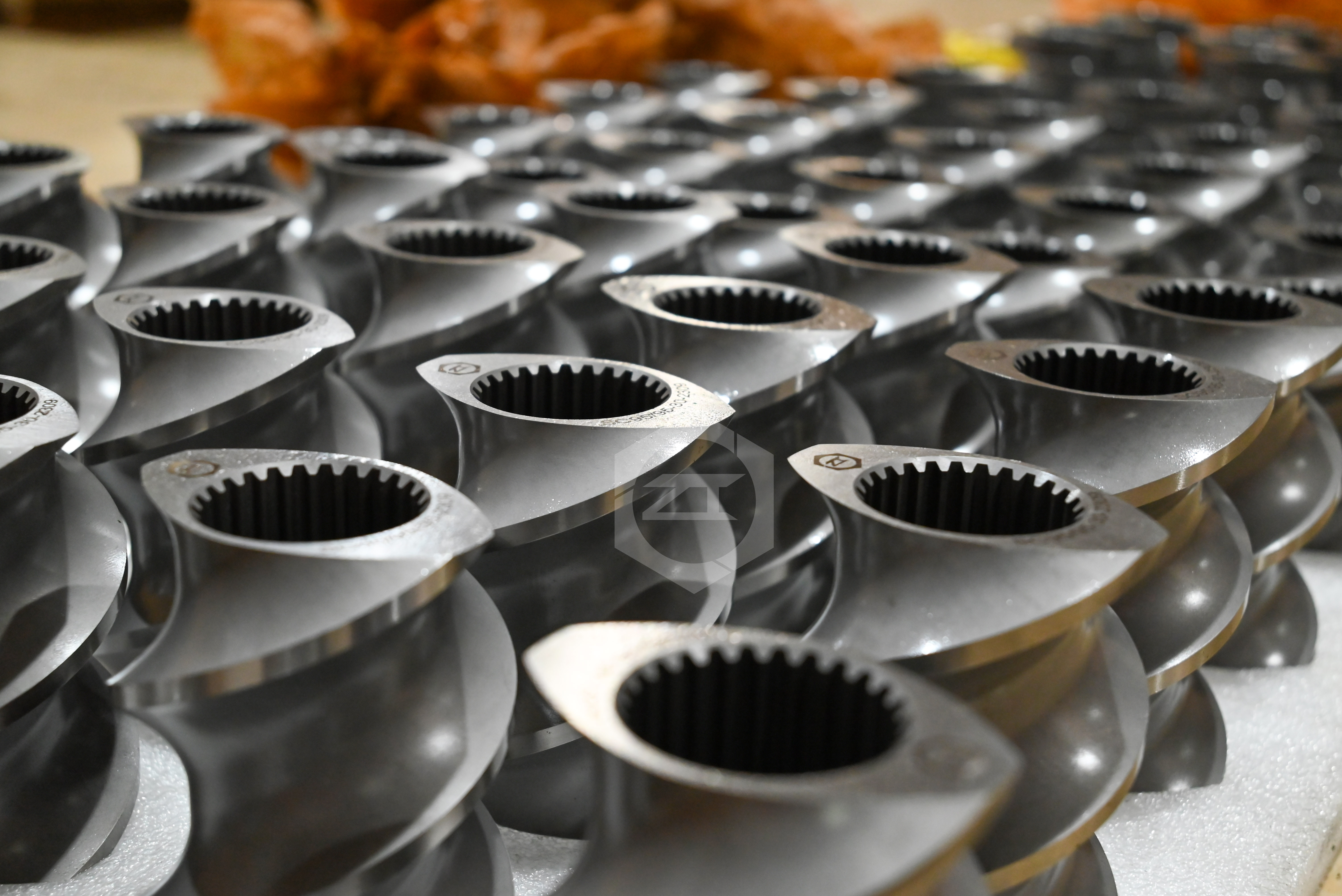
* Convey Screw Segment
* Mixing Screw Segment
* Kneading Block & Disk
* Transition Screw Element
* Deep groove transfer element
* Screw element for side feeder
* 1-flighted,2-flighted,3-flighted screw elements
![]()
The combination of twin screw thread elements in a co-rotating parallel twin-screw extruder can vary based on the desired functionality and material processing requirements. Here are some basic knowledge points about twin screw thread element combinations:
MODULAR DESIGN: Twin screw extruders are designed with multiple sections that can accommodate different types of screw elements. This modular design allows for flexibility in configuring the screw elements based on the specific processing needs of different materials. The sections can be easily modified or replaced, enabling customization and adaptability in material processing.
MIXING ELEMENTS: Twin screw extruders commonly incorporate mixing elements alongside conveying elements. Mixing elements are specialized screw elements that enhance the mixing and dispersion of materials within the extruder. They facilitate thorough blending of components, improve the distribution of additives or fillers, and enhance the overall quality of the final product.
BARRIER ELEMENTS: Barrier elements are used to create separation between material streams within the extruder. These elements are strategically positioned along the screw channel to improve the distributive mixing of different components, such as additives or fillers. By optimizing the flow and distribution of materials, barrier elements contribute to achieving a more homogeneous mixture.
TEMPERATURE CONTROL: Twin screw extruders can include screw elements with internal cooling or heating capabilities. These temperature control elements assist in maintaining precise thermal management during processing. They enable efficient heat transfer to or from the material, allowing for accurate temperature control and management of materials with specific temperature sensitivities.
REVERSE CONVEYING: While most screw elements are designed for forward conveying, reverse conveying elements can be utilized in specific situations. These elements help remove any material that may accumulate or cause blockages within the extruder. By preventing material build-up and potential equipment issues, reverse conveying elements ensure smoother operation.
The selection and arrangement of screw elements in a twin screw extruder should consider the specific processing requirements, material characteristics, and desired outcomes. Manufacturers and engineers carefully design the extruder to optimize its performance and achieve the desired product quality.
More Twin Screw Extruder Barrel Videos
![]()
- APV -KOBE -OMC
- Buhler -KraussMaffei -Theysohn
- Buss -Berstorff- -Toshiba
- Clextral -Labtech -USEON
- Coperon -Lantai - others
- JSW -Leistritz
- Keya -Maris
* Convey Screw Segment
* Mixing Screw Segment
* Kneading Block & Disk
* Transition Screw Element
* Deep groove transfer element
* Screw element for side feeder
* 1-flighted,2-flighted,3-flighted screw elements
![]()
The combination of twin screw thread elements in a co-rotating parallel twin-screw extruder can vary based on the desired functionality and material processing requirements. Here are some basic knowledge points about twin screw thread element combinations:
MODULAR DESIGN: Twin screw extruders are designed with multiple sections that can accommodate different types of screw elements. This modular design allows for flexibility in configuring the screw elements based on the specific processing needs of different materials. The sections can be easily modified or replaced, enabling customization and adaptability in material processing.
MIXING ELEMENTS: Twin screw extruders commonly incorporate mixing elements alongside conveying elements. Mixing elements are specialized screw elements that enhance the mixing and dispersion of materials within the extruder. They facilitate thorough blending of components, improve the distribution of additives or fillers, and enhance the overall quality of the final product.
BARRIER ELEMENTS: Barrier elements are used to create separation between material streams within the extruder. These elements are strategically positioned along the screw channel to improve the distributive mixing of different components, such as additives or fillers. By optimizing the flow and distribution of materials, barrier elements contribute to achieving a more homogeneous mixture.
TEMPERATURE CONTROL: Twin screw extruders can include screw elements with internal cooling or heating capabilities. These temperature control elements assist in maintaining precise thermal management during processing. They enable efficient heat transfer to or from the material, allowing for accurate temperature control and management of materials with specific temperature sensitivities.
REVERSE CONVEYING: While most screw elements are designed for forward conveying, reverse conveying elements can be utilized in specific situations. These elements help remove any material that may accumulate or cause blockages within the extruder. By preventing material build-up and potential equipment issues, reverse conveying elements ensure smoother operation.
The selection and arrangement of screw elements in a twin screw extruder should consider the specific processing requirements, material characteristics, and desired outcomes. Manufacturers and engineers carefully design the extruder to optimize its performance and achieve the desired product quality.

More Twin Screw Extruder Barrel Videos